A 80 weeks trip around the world

Discover a daily picture from the trip, as well as writings on street photography.

Trip update : In Benares (Varanasi)

In the world's oldest city for a week. With a view on the Sacred Ganges waters.

Featured article

The top 12 destinations for street photography: Planning a holiday to shoot ? Have a look at some suggestions.

Follow me

Add me on Google+    Follow me on Twitter       
 

The best way to have a view on Benares is to take a boat trip. We haven't done so yet but will in the coming days. The main piers are a sight as boats find their way and unload passengers. Pilgrims send flowers to the Ganges next to it and kids go for a swim. More surprising, an Indian woman asked me why I did not bath in the Ganges. When I told her the water was not good for my health, she stared at me in disapproval. The Ganges is sacred in India and somehow people don't care that the pollution level is hundreds of times above the contamination limit. The divine can more than science. (click on pictures for high res)

All pictures with Leica M9 and 50mm Summicron, except #1 and #4 with 35mm Lux Asph


It is 5 am. We woke up early to avoid the heat. Well, kind of since it is still 32C out there. We are not alone as hundreds converge to the piers. They slowly undress, take a bath in the Sacred Ganges and then dress again meticulously. A slow ritual that has been going on for thousands of years. (click on pictures for high res)


If you hit the ball and it ends up in the water, you get 6 runs. And a swim in the filthy Ganges water. (click on picture for high res)

Leica M9 with 35mm Lux Asph at F1.4, 1/350, ISO160


… and we almost went back home early. When we planned the trip, we knew we would reach India in middle of the summer time. May and June are the hottest month and believe me, it is becoming unbearable. I have been getting up at 5am to enjoy a little bit of cool air and by 9am, better run to find some shadow. And it is about to get worse as we head tonight to Benares where temperature of 45 celsius are expected.

Given the circumstances, we have decided to cut back on our destinations and stay longer in each of them. :

- Varanasi : 7 days

- Calcutta : 4 days

- Pondicherry : 14 days

- Cochin : 7 days

- Mumbai : 7 days

Leica M9 with 35mm Lux Asph at F1.4, 1/4000, ISO160


They live in a humble way on top of the Rishikesh piers. Their daily bath is taken in the river and they probably never eat meat since the town is holy place. Kids play running down he stairs of the ghats, a bit like of an Indian Ingalls family I guess.
Rishikesh family


At time of sunset, hundreds of pilgrims converge to the ghats (piers) to perform rituals to honor the Sacred River, the Ganges. Some honor the dead, others bath to purify themselves. Luckily, the river is still clean in Rishikesh (I did also take a bath in it to purify all my sins), it will be another story once we reach Varanasi next week.  (click on pictures for high res)

Pictures #1 and #3 with Leica M9 and 35mm Lux Asph,  #2 and #4 with 50 mm Cron


Yesterday saw the launch of the Leica M Monochrom, that is the first digital camera in history with a black and white sensor.

I am sure it will cause the rise of quite a few eye-brows, indeed why produce such a camera? Why not simply convert to B&W when needed and keep color capability ? Without getting into technicalities, a B&W only sensor will produce sharper pictures since it does not have to interpret colors. It will also allow higher ISO performance (up to IS010'000) compared its color sibling (M9). So really, for people that exclusively shoot B&W, like to hang out in dark jazz clubs, and want the ultimate performance, this is the dream camera. Of course if one can afford the hefty $8'000 price tag.

Leica also announced a new lens, that is the 50mm Summicron F2 APO at a price of $7'000. So if you do believe you are the modern reincarnation of Henri Cartier-Bresson, it will take $15'000 of your cash to match his gear with Leica's best in their current product line (M Monochrom + 50mm Cron APO). I guess you now wish you'd reincarnated in Warren Buffet and be a lousy photographer. Otherwise, buy a film Leica and process your B&W's at the local lab. (before it becomes a restaurant … see last picture below)

Inspired by Leica's new product announcement, I set my normal Leica M9 into B&W mode this morning and hit the streets of Rishikesh. The pictures below are all out of camera JPG's which some curves adjustments. In my opinion, the pictures are already plenty sharp, I don’t see any need for more in street photography.

And anyways, color rules, doesn't it ? (click on pictures for high res)

All pictures taken with Leica M9 and 35mm Lux Asph


The use of foregrounds is a technique often seen in reportage, yet is somehow left aside in street photography. The reason for that ? It adds one more dimension to the already complex process of recording a candid scene (unlike reporters, street photographers have zero control on their subjects and surroundings). It is no more only about a subject and its background, the foreground now needs to be monitored. The decisive moment becomes a function of two planes, both in terms of composition and timing.

Putting its complexity aside for a while, let's therefore have a look at how a foreground can be used to enhance your street photography :


1) Give a sense of depth : A picture is a 2D representation of a 3D space. Depth is per say not present in a picture but can be added through visual tricks. Placing a foreground is one of them since it will detach the subject from the first plane.

The scene below could have been a simple 2D landscape of a sunrise in Pune, India. By adding the woman in the foreground, depth was added and an impression of three dimensionality is created. Note that it also provides a reference of scale and distance between the planes.


2) Add dynamism / movement : Your main subject might often remain static in a moving environment such as a crowd. A foreground can therefore help to give a feeling of movement, or dynamism, to your shots. Note that if you use a large sensor camera, foregrounds will usually result blurred since the depth of field is not be large enough to encompass both your subject and the first plane. This is good news because our eyes often associate blur with motion, adding to the desired effect.

I shot the scene below in two different ways. The first shot has no foreground and depicts a pilgrim praying by the Golden temple in Amristar, India. The location seems totally deserted.

The second shot adds two pilgrims in the foreground which creates movement in the scene. It provides a better view on the atmosphere of that morning since thousands of Pilgrims were walking around the pond.


3) Provide information on the photographer's location: In what location was the street photographer when he took the picture ? In many cases, it does not really matter since the subject and his background are enough to depict a scene. Yet in some instances, a very close foreground can enhance a picture by providing extra information on where the shot was taken from.

In Pune, India, I was walking behind a wall when an opening allowed me to have a clear view on a cricket field. I therefore used that same wall as foreground since it both showed my location and the feeling of discovery I experienced at that moment.

In this second shot, I was riding in a train in Yangoon, Myanmar. The woman was running to catch the train. The man in the foreground clearly positions the photographer as a passenger in a train.


4) Create a vertical interaction :  Most pictures with multi-subjects interact following a horizontal scheme. In other words, they are located on roughly the same plane and the picture is read from left to right (or reverse). The use of a foreground adds the possibility of a vertical interaction, meaning that subjects now interact between planes. Obviously, it can also be easily done by combining a subject and its background.

The scene below depicts a woman contemplating bathers at the Monkey Temple in Jaipur, India. There is a vertical interaction between the woman and bathers which is enhanced by the glance of the man in the swimming pool.


5) Hierarchize subjects : When a picture has several planes, the use of a foreground (or background) can help hierarchize the importance of the subjects as perceived by the photographer. If your foreground results blurred, this hierarchy will be further enhanced as your eyes will be directed to the subject in focus.

The expression of the woman in the picture below is the key of the scene. Her kid adds an element to her story, yet your eyes are directly led to the woman's face.

The same analysis is valid for the following shot. Our eyes are lead first to the kid whose glance brings us back to the foreground.


6) Compose out of the box :  Classic compositions always work, yet they might sometimes feel a bit too cliché or déjà vu. Adding a foreground might help you to venture out of the beaten paths and add some creativity to your street photography.

The shot below is pleasing in terms of colors and subjects. Yet it is a classic composition and probably has been done many times with slight variations.

By adding an improbable foreground, the shot takes a new dimension and dynamism. The viewer now finds himself analyzing the picture and trying to understand what is really happening. The main subject remains the two veiled women but something else is going on in this scene for the viewer to discover.


7) Improve aesthetics of a shot : The addition of a foreground is sometimes a purely aesthetic decision. The picture just looks better this way. There is no connection between subjects except in terms of mood, atmosphere or light.

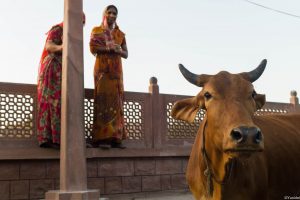
The picture below was an instinctive snap. I was attracted by the reflection of the light in the man's hair which I thought gave a good counterpoint to the sunset. The main subject of the picture is obviously the cows laying in the middle of a Jodhpur street.


8) The hand of hazard : Finally, let's mention the hand of hazard. When readying for the decisive moment, some unwanted foreground might suddenly force their way into your frame (especially for those of you that don't use rangefinder ;) ). 99% of the time, the shot will be ruined, but every once in a while, you'll get a creative keeper.

Ok, I admit it, I did not anticipate the girl running into my frame in this Sydney street. I would not have kept this shot if she had not entered my field of view.


So, convinced that foregrounds can help your street photography ? Hit the street and start practicing. Be ready though for a huge failure rate at the beginning, the decisive moment is now longer on a single plane.


No, the world has not been completely taken over by dandies and metrosexuals. Real men still exist, you'll find them in Punjab  (click on pictures for high res)

All pictures taken with Leica M9 and 35mm Lux Asph, except #3 with 50mm Summicron.


Several guards protect the sacred water of the Golden temple. So if you ever throw yourself into the waters, swim fast because you'll be soon surrounded by a small army of fierce warriors. Joke apart, they make sure that the protocol is respected in the holiest plase of Sikhism.  (click on pictures for high res)

All pictures taken with Leica M9 and 35mm Lux Asph

© 2012 Yanidel Street Photography Suffusion theme by Sayontan Sinha