Aug 282012
 

Often wrongly considered as a gimmick in street photography, the capability to blur backgrounds (or foregrounds) is to the contrary a wonderful creative tool when used appropriately. To illustrate it, let's have a look at two similar pictures taken in Paris by Notre Dame. In both cases, the focus was set on the little girl being portrayed by the painter. An aperture of F4.0 was used in the first frame while the second was taken with an aperture of F1.4 (on the 60mm Konica Hexanon F1.2).  What are the key differences generated by these two different exposure settings ?
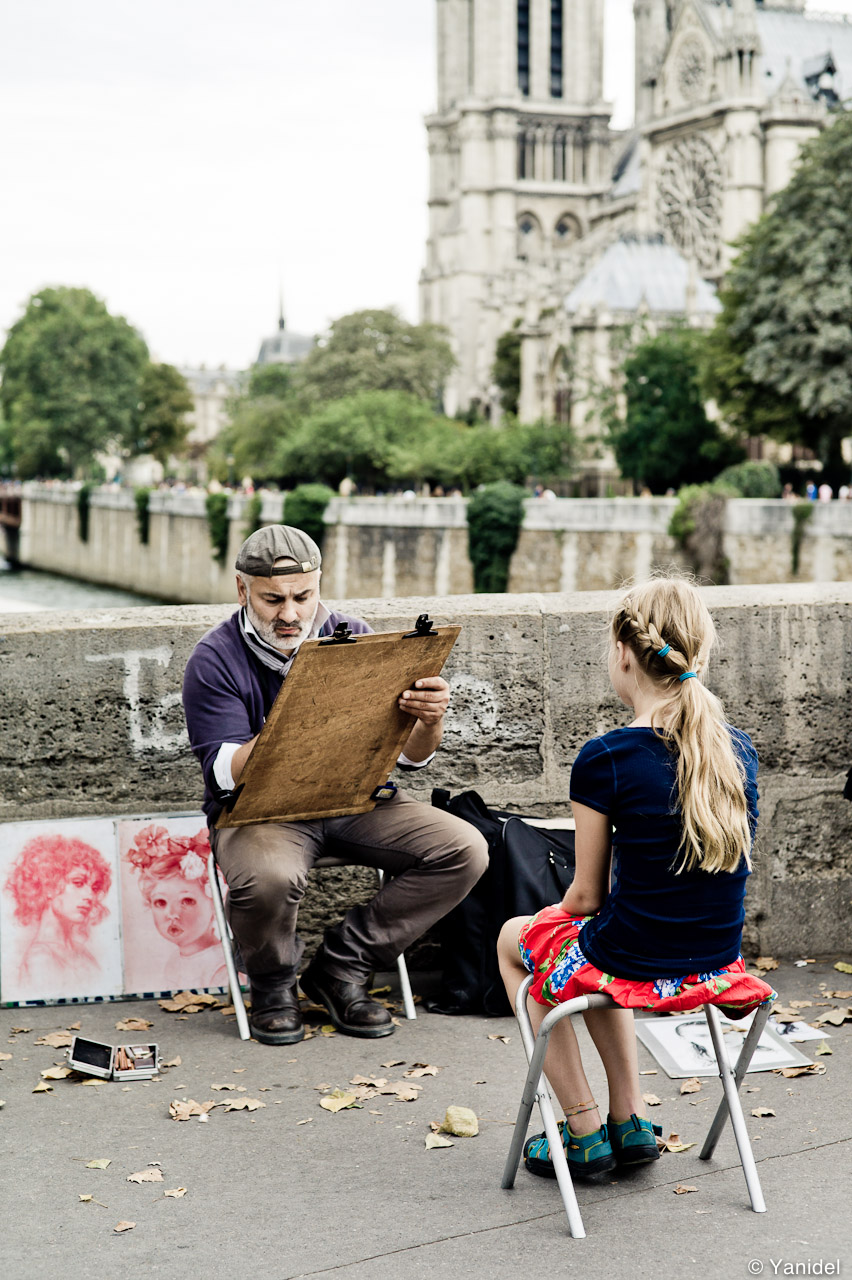
In this first picture, the mid aperture choice generates a depth of field where both the painter and little girl are in focus. Due to the full frame sensor of the Leica M9, the Notre Dame cathedral results partially out of focus, yet it will be only noticeable in relatively large magnification ratios. One could say that this picture is an exact reproduction of the scene as witnessed by the photographer.

Have a look now at the second picture, taken with an aperture of F1.4. The only plane that results completely in focus is the head of the little girl. Due to the 60mm focal and the large aperture, the head of the painter is already partly out of focus. Notre Dame is now significantly out of focus and resembles almost an impressionist painting. The resulting picture is a creative representation of reality.
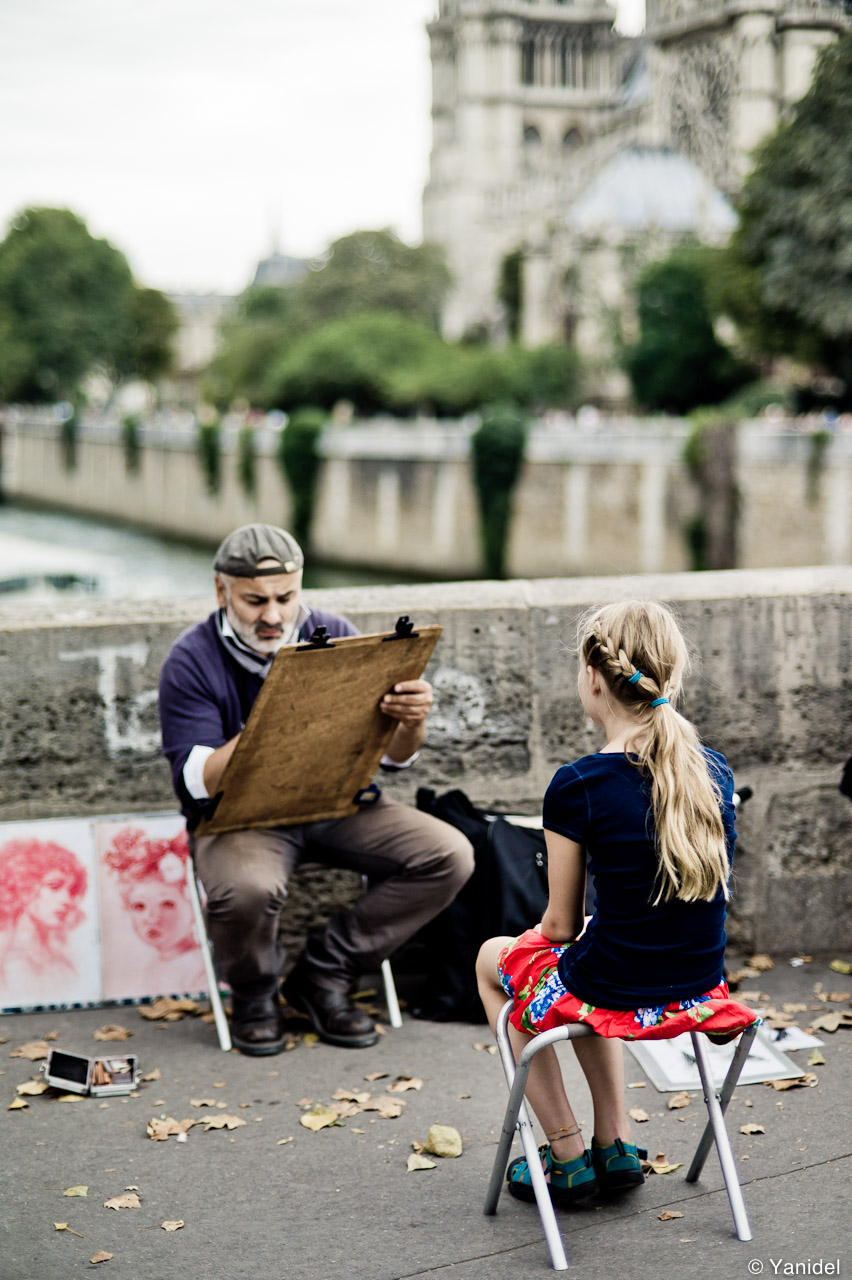
So which is better? There is no absolute answer, here what we are really talking about is personal taste. The second picture has in my opinion a more poetic dimension, which depicts well the essence of Paris. Also, I consider the use of blur as as a key attribute of my street photography. In some ways, I like to think about my pictures as a mimic of my fading memory; some details remain always clear, while some disappear with the pass of time. But again, this is personal and I'd be interested to hear about other opinions (please use the comments section below)

Now, the use of thin depths of field and the resulting blurs must be used cautiously, and in some cases even avoided :

- when your main goal is to impress your friends with an effect that they cannot reproduce with their IPhone or compact cameras. Blur does not make a photographer better by itself.

- when used to hide lousy composition skills. Blur won't make unwanted elements magically disappear. They'll just become less easily identifiable. Any composition fault will remain and nobody will be fooled, except maybe for your aging mother.

- just because you recently acquired that expensive 50mm F0.95 lens does not mean that you have to shoot exclusively wide open to amortize it. Fast lenses come with a full range of apertures, use them when needed too.

- finally, in case you did not know, let's mention that Bokeh does not mean "great picture" in Japanese.

Blur is no gimmick and can be enhance a lot your creative approach to street phtotography, when used appropriately. It does require some technique to get your focus right since a slight error will impact immediately your picture. Yet it can be done with some practice, so mount that fast lens on your camera and hit the street.


  15 Responses to “To blur or not to blur”

  1. Nice little article. Agree with you, there is a snobbishness by some street photographers who think that having depth of field in your photos instantly renders them not 'not street photography'. Some think that their opinion is the right one. 
    I say shoot how you feel comfortable. I definitely go through phases when it comes to shallow DoF in my photos, but it depends which lens I'm using that day. My 35mm f/2 dosen't really have any separation whereas my 50mm f/1.4 is perfect for shallow DoF. 50mm lends itself to shallow DoF photos I think. 
    I like to think I have the balance right between when to and when not to blur out foreground/background. 
     

    • You are right, but sometimes the decision must be made in a split second so we use thin depth of field when we should not. As for the 35/2, you can get pretty good blur if you get within 1.5 meter of your subject.

      Cheers.

  2. #next_pages_container { width: 5px; hight: 5px; position: absolute; top: -100px; left: -100px; z-index: 2147483647 !important; }
    Hello sir. Good advice and I agree, the F1.4 one is indeed more poetic. But I wonder if the colours on your images are equally responsible for the "poetic" feel in your photos. I've been a fan of yours (especially the Paris street shots) for almost a year since I started to take an interest in photography…or rather looking at photos (still don't have a camera other than the iPhone).
    I check your site often, hoping to find an article on how you post process your colour photos. Or is that just Paris magic? 
    Thanks for sharing your passion and being generous with your expertise.
    BB
     

    • Hi BB, indeed the colors are also part of the poetic feel. Yet since both pictures were processed, I think the blur introduces even more of that effect.

      As for my post-processing, it will remain secret for years to come.I still hope you’ll keep on checking my website. ;)

      Cheers, Yanick

      • #next_pages_container { width: 5px; hight: 5px; position: absolute; top: -100px; left: -100px; z-index: 2147483647 !important; }
        :(. I'm sad but it's a good secret to keep. I'll keep checking your website to look at your photos which are not just inspiring to photography but also to the human spirit.
         
        Cheers,
        BB
        #next_pages_container { width: 5px; hight: 5px; position: absolute; top: -100px; left: -100px; z-index: 2147483647 !important; }
         

  3. Personally, I prefer the first shot. Having the painter in focus accentuates the intimacy between him and the girl. It makes it seem as though they are absorbed within their own little world where the girl is focused on keeping still and the painter is concentrating on the girl before him.
    I would have snapped something similar to the second shot because I shoot wide open most of the time at f/1.4. Thanks for the article, Yanidel. It reminds me that I should keep my photographic eye open to seeing at different apertures instead of visualising the shots with very shallow depth of f ield.

  4. The first photo is much better. The second photo may be poetic, but it loses too much.

    • I think the first one is more classical while the second one is a bit abstract. I understand both points of view, I would have a hard time to choose which one to print.

  5. Although I enjoy your shallow focused shots a lot, the first one gives me a strong feeling of being there, especially if I switch back and forth between the two.  That said, I can't help imagining how it would be if the focus were instead on the eyes of the artist…  A nice and interesting comparsion anyway.  Thanks!  :)

    • Hmm, the shallow focused shot looks better if enlarged to 1:1.  My eyes are always drawn to the artist initially.  However, at a smaller size, the girl is not significantly sharper.  For a fraction of a second I felt puzzled about the real subject of the shot.  Probably the unrest pushed me toward the first shot.

  6. Interesting question and article. I’d like to point tow other parameters in this equation: 1. Since to shot is color and not B&W, the “accessories” are disturbing the “essentials”; and 2. (in conjunction with n°1) In this particular case, this sensation is accentuated by the “not pretty” monument in background; not pretty, cause decapitated; if the monument (the cathedral) have been a little farther and not cut in this way, then the first shot have been better for me. Now, I prefer the second one, me too. :-)

    • Hi Julian, “not pretty” is indeed not the best term to describe Notre Dame ;). Such an amazing site, but I understand your point. I often feel it is better to show only parts of buildings, monuments, …. it generates more creative framings then having always the full structure in.

      I could have shot it from farther, yet I would have lost depth due to the bridge (and the bit of the Seine River). So I am not sure it would have been better. Who knows? Sometimes you gain some, you lose some. Cheers.

  7. Great shot – much prefer the second one at f1.4 over the first.

 Leave a Reply

(required)

(required)

You may use these HTML tags and attributes: <a href="" title=""> <abbr title=""> <acronym title=""> <b> <blockquote cite=""> <cite> <code> <del datetime=""> <em> <i> <q cite=""> <strike> <strong>